Most real decisions have at least two goals. Decrease cost and increase performance, increase yield and purity, or quicker and healthier in the case of your dinner. How you optimise for these goals can fundamentally change the answer you end up with.
Take a simple everyday problem: deciding what to cook for dinner, ideally something quick and healthy.
- Goal one is to reduce cooking time.
- Goal two is to improve healthiness.
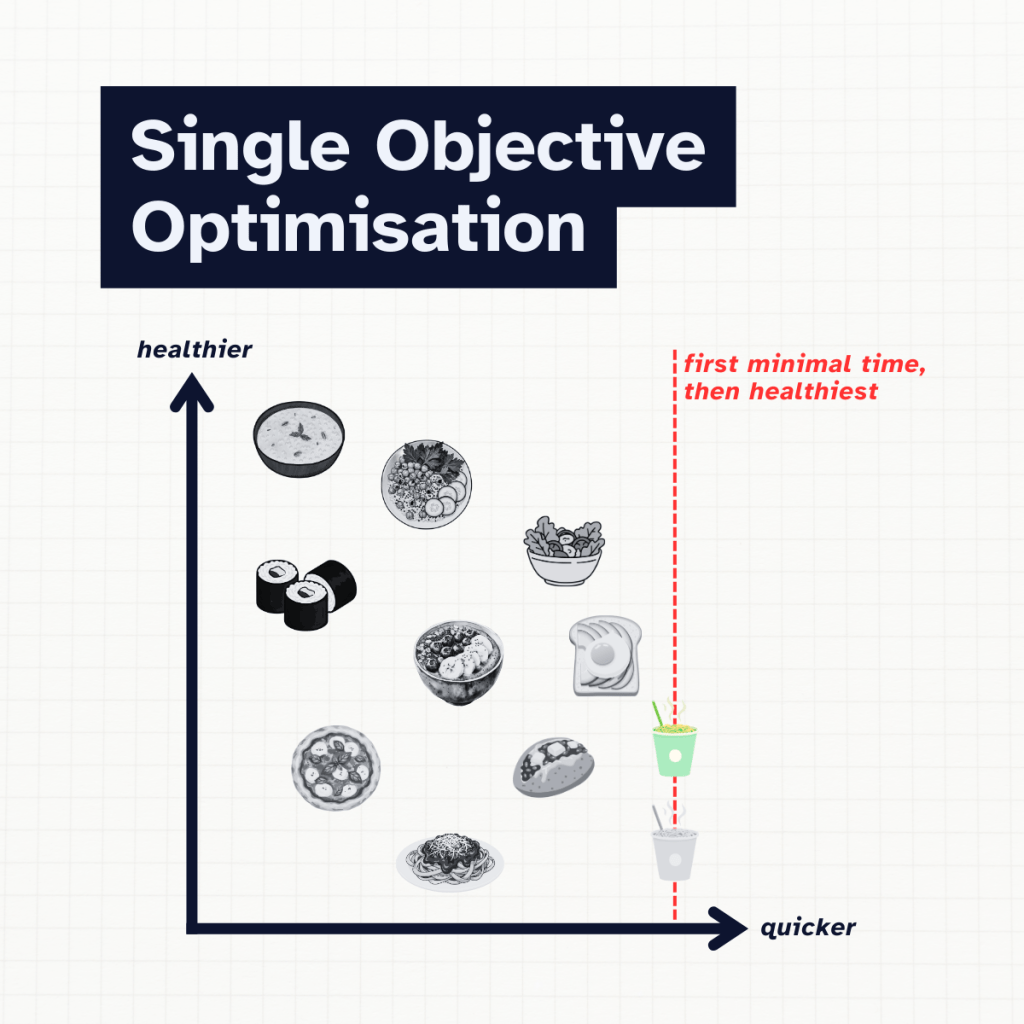
If you optimise sequentially, you might look at everything you could cook and optimise only for time first. The quickest option could be a two minute meal (e.g. instant noodles). Then you keep cooking time fixed at two minutes and ask: what is the healthiest thing I can make in two minutes? You are pretty much stuck with instant noodles and might end up with a low sodium ramen. You have optimised both goals, but you have also narrowed the search space very early.
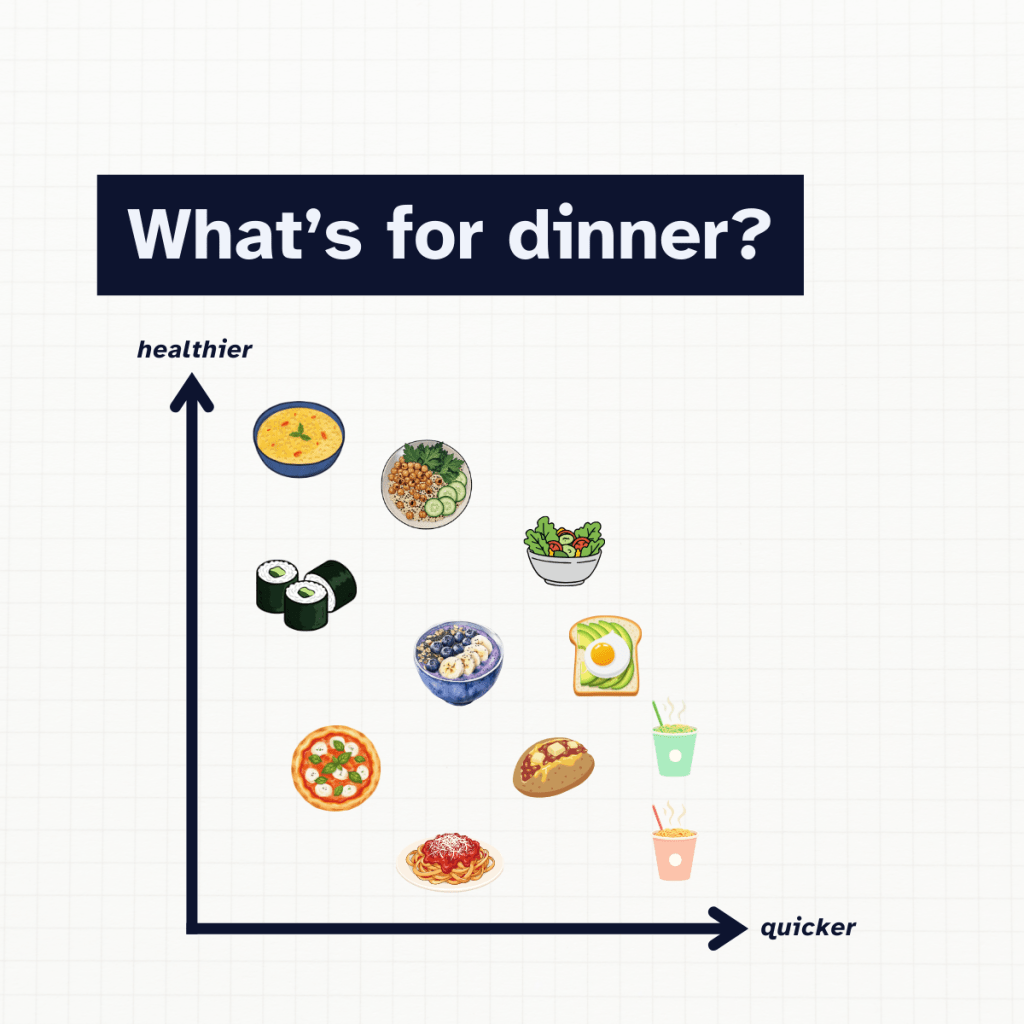
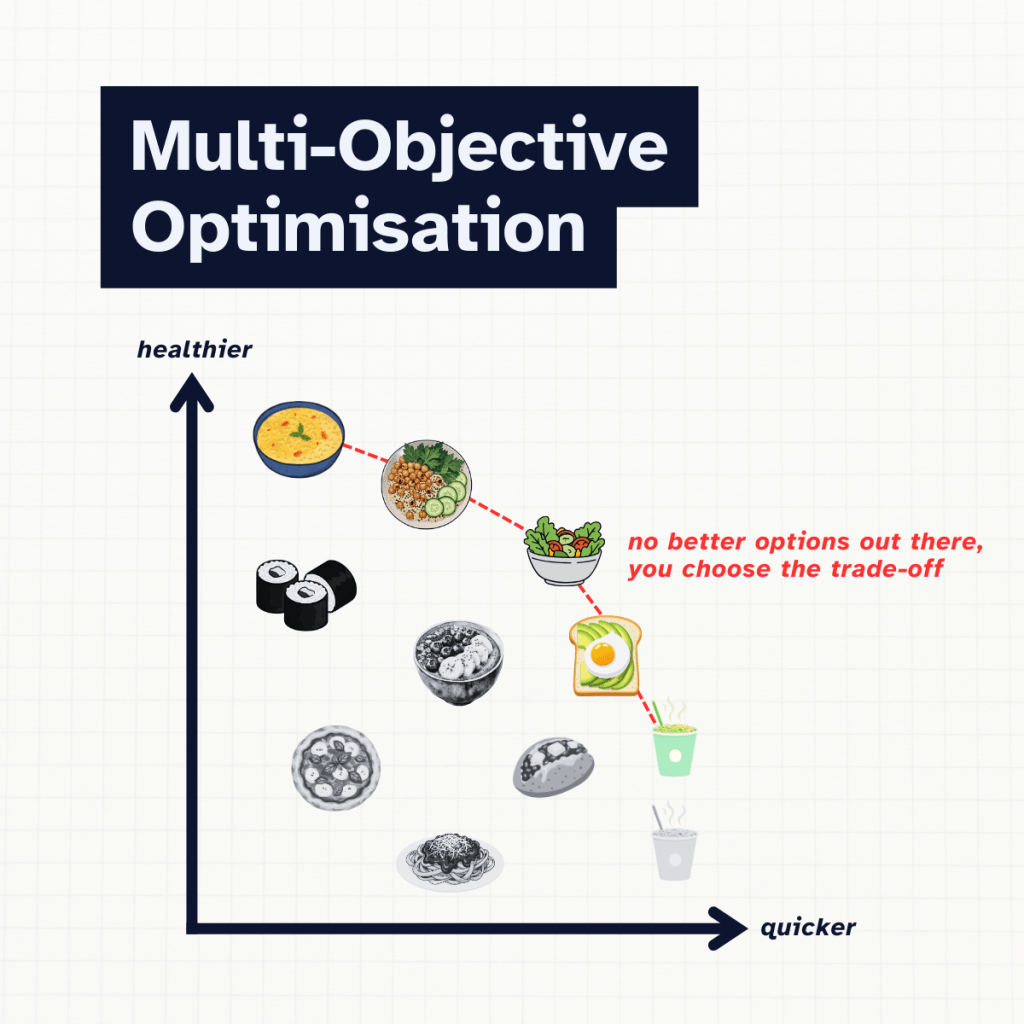
Now consider looking at both goals simultaneously. You evaluate recipes on cooking time and healthiness at the same time. You look for options where there is no other recipe that is BOTH quicker AND healthier. Instead of one answer, you get a small set of sensible recipes: healthier but a little longer, very quick but not as healthy. These might be a lentil dal, a chickpea quinoa bowl, a loaded salad, avocado and eggs on toast, and the low sodium instant ramen.
Interestingly, low sodium ramen is also in that set – as we have already figured out that this is the healthiest recipe for a certain cooking time, i.e. there are no other recipes out there that are BOTH quicker AND healthier.
That set is called the Pareto front. It does not give you a single winner. It shows you the boundary of best trade offs, and lets you choose based on what matters most in that moment. Maybe you’ve got time in the kitchen and whip up a dal, maybe you have to settle for avocado and eggs on toast on a busy day.
This difference between single objective/sequential and multi-objective/joint optimisation has relevance outside of your meal plan as well. It shows up in bioprocessing all the time. Media and process parameters influence titre, yield, quality, and cost together, however they are often optimised sequentially instead of jointly. If you optimise one metric first and lock it in, you can easily miss combinations that are slightly worse on that first metric but much better overall.
If you care about more than one thing, optimise like you mean it.

 Isabella Deutsch
Leave a comment